
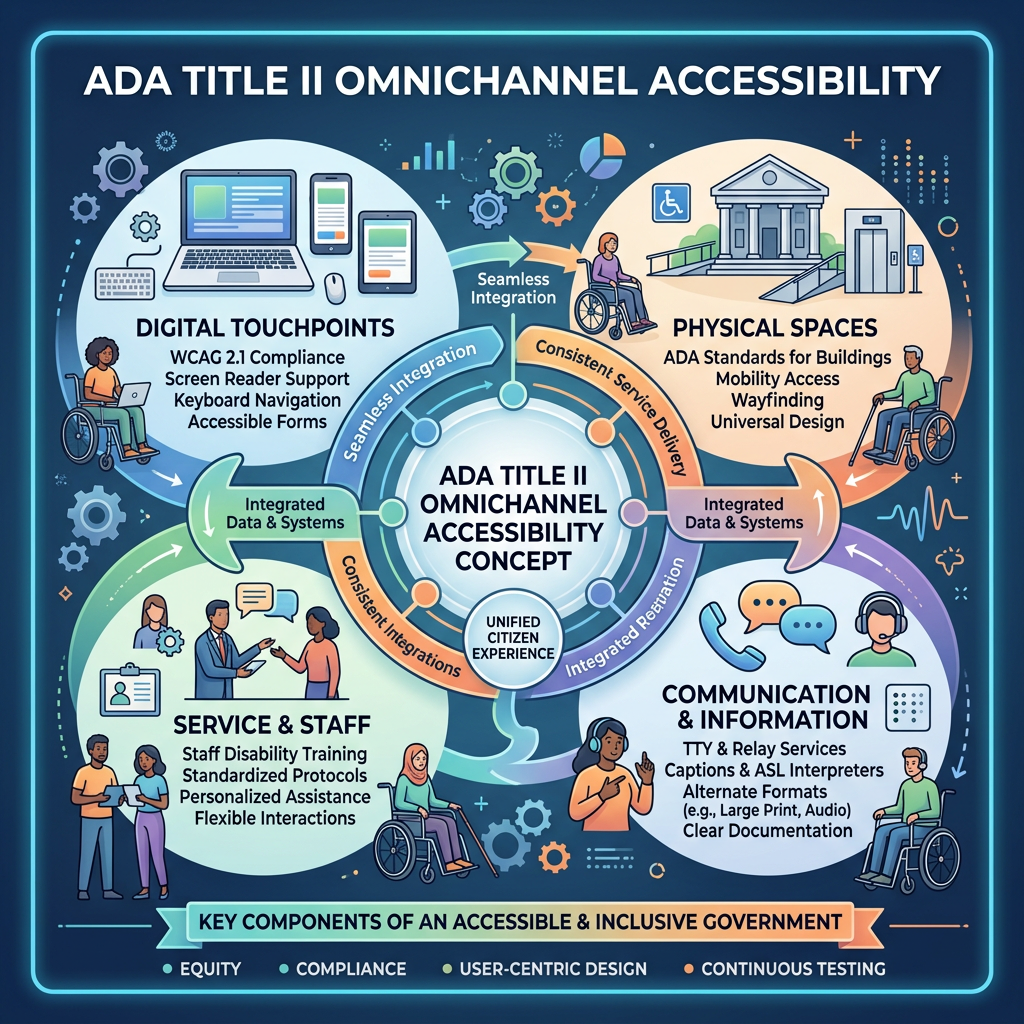
ADA Title II is often framed as an accessibility requirement for government organizations. In reality, it is a system‑level mandate that is already reshaping how both public and private organizations must design, govern, and deliver services across channels.
Seen through an omnichannel lens, ADA Title II is not about remediating a website or fixing a PDF. It is about whether the entire experience ecosystem works together to deliver equal, effective access—and whether organizations are prepared to operate that way at scale.
With new federal compliance timelines now formally in place, this is no longer a distant consideration. The clock is running, and its impact extends well beyond public entities alone.
What Is ADA Title II?
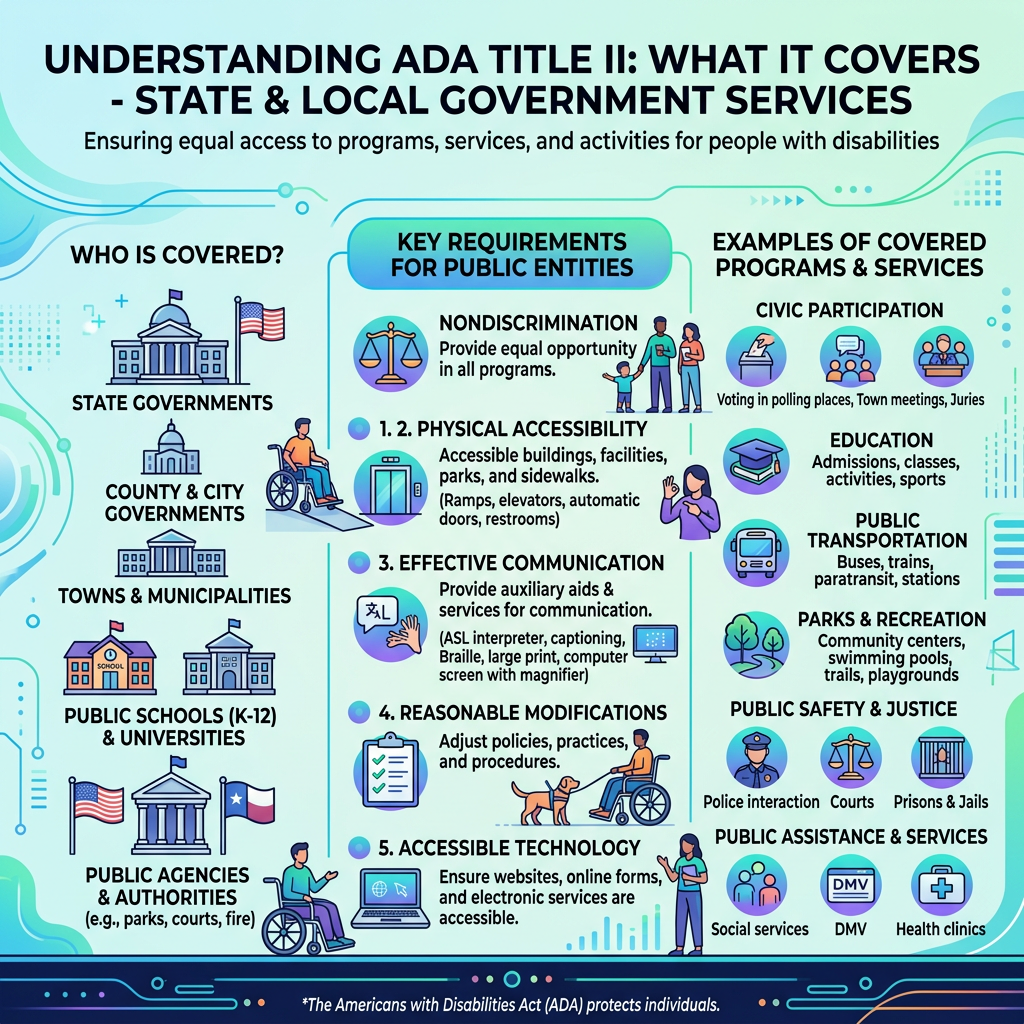
ADA Title II applies directly to state and local governments and any entities delivering services on their behalf. It requires people with disabilities to have equal access to all programs, services, and activities provided to the public.
This includes:
- Physical locations and in‑person services
- Websites, portals, and mobile applications
- Digital documents and online forms
- Communications delivered by staff, systems, or platforms
The principle is simple:
If a service is available to the public, it must be usable by the public—without added friction or alternate paths for people with disabilities.
What Title II Really Means in an Omnichannel World
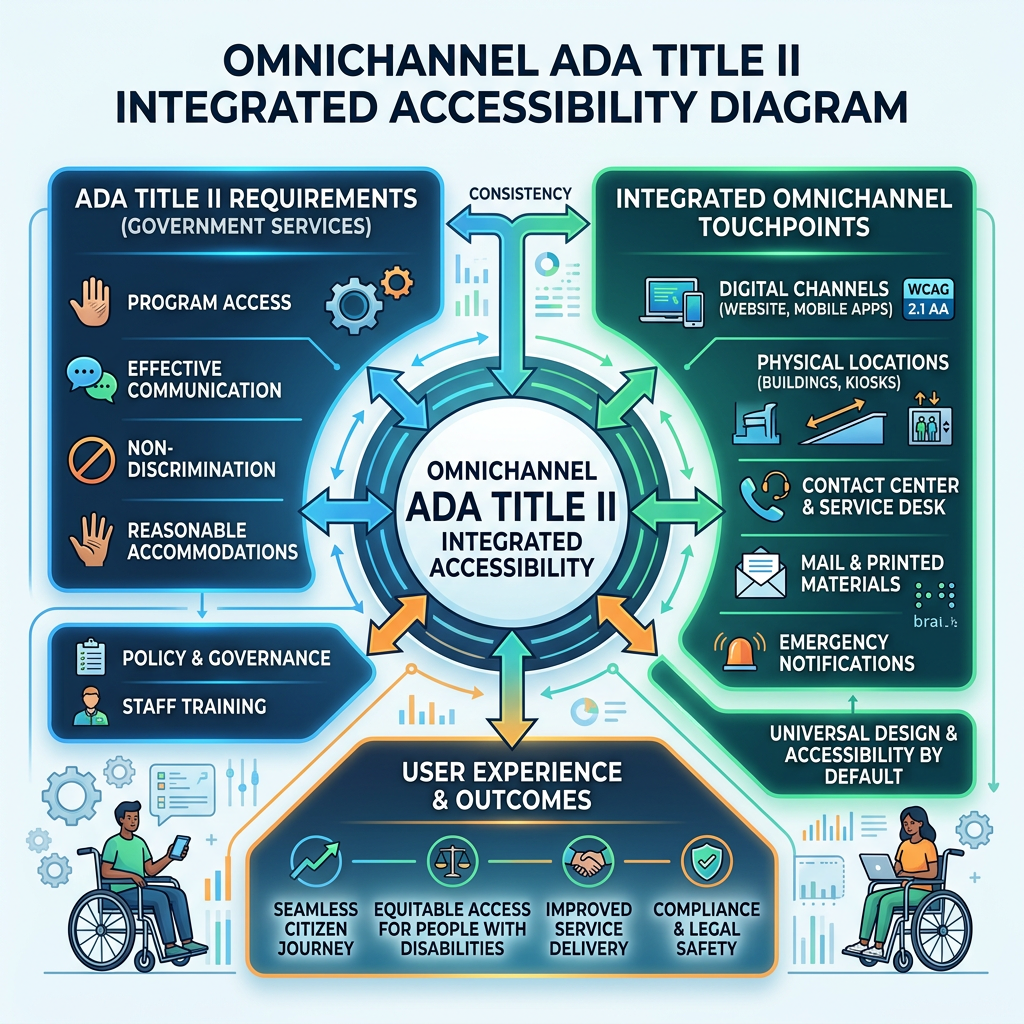
One phrase in the regulation changes how leaders need to think: programs are evaluated “when viewed in their entirety.”
That is an omnichannel concept—whether the regulation uses the word or not.
In practice, it means:
If a service is delivered through multiple channels, those channels together form one system—and that system must be accessible.
An accessible website does not compensate for an inaccessible mobile app.
An accessible document does not excuse an inaccessible workflow.
A call center is not a substitute for an inaccessible digital experience.
Under Title II, the weakest channel defines the experience.
What Has Explicitly Changed: Clear Federal Deadlines
In April 2024, the U.S. Department of Justice issued a final rule formally clarifying that digital services—including websites, mobile apps, and digital documents—are covered under ADA Title II and must meet WCAG 2.1 Level A and AA standards.
In April 2026, the DOJ issued an Interim Final Rule extending the original compliance deadlines. The current deadlines are:
- April 26, 2027
For state and local government entities serving populations of 50,000 or more - April 26, 2028
For entities serving under 50,000, including special district governments
These dates are now fixed and enforceable.
Does ADA Title II Apply to Private Corporations?
Directly? No.
Practically? Increasingly, yes.
ADA Title II legally applies to public entities. However, private corporations are already deeply in scope in three critical ways:
1. Vendors and Technology Partners Are Included by Design
If a private company provides:
- Software
- Platforms
- Digital services
- Content
- Customer‑facing tools
to a public entity, that company’s product becomes part of the public service system. The accessibility obligation flows through procurement, contracts, and operational dependency.
In effect:
If your product is how the public accesses a government service, your product must meet Title II standards.
2. Title III (Private Sector ADA) Already Uses the Same Standards
Private corporations are regulated under ADA Title III, which governs places of public accommodation. While Title III does not yet have the same explicit digital deadlines, courts have consistently used WCAG 2.1 AA as the benchmark for accessibility claims.
The DOJ’s adoption of WCAG 2.1 AA under Title II further cements this standard across the ADA ecosystem—including for private organizations.
3. Enforcement Pressure Is Already Shifting to Private Companies
Private organizations—especially smaller and mid‑sized companies—are already facing rising enforcement and litigation tied to digital accessibility.
The practical outcome is clear:
- Public entities will require accessibility guarantees from vendors
- Private companies that sell into the public sector will be contractually bound
- Digital accessibility expectations will normalize across industries
No new law is required for this shift to continue.
When Is This “Coming” for Private Corporations?
There is no announced federal deadline extending ADA Title II directly to private corporations.
However, from a system reality standpoint:
- Now–2026: Public entities formalize expectations and vendor requirements
- 2026–2028: Accessibility becomes a procurement‑level requirement at scale
- Ongoing: Title III litigation and enforcement continue using WCAG 2.1 AA
For executive teams, the question is no longer if expectations will converge—but whether systems are designed to handle that convergence without disruption.
The Do’s: What Organizations Should Be Doing Now
Regardless of legal classification, the strategic moves are the same.
✅ Design Accessibility at the System Level
Treat accessibility as an omnichannel design outcome—not a feature.
✅ Align Governance Across Channels and Vendors
Fragmented ownership is the largest source of risk.
✅ Build Accessibility Into Operating Models
Reactive fixes don’t scale. System design does.
The Don’ts: What Will Not Hold Up
❌ Don’t Treat Accessibility as a One‑Time Fix
Deadlines expose structural debt.
❌ Don’t Assume “Indirect” Means “Optional”
Market and contractual pressure travel faster than regulation.
❌ Don’t Rely on Workarounds
Separate paths equal unequal access—legally and experientially.
How Leaders Should Be Thinking About This
Title II is not just a regulation. It is a forcing function.
It forces organizations to confront:
- Fragmented channel ownership
- Inconsistent experience design
- Platform sprawl
- Accessibility treated as an exception, not a principle
Through an omnichannel lens, ADA Title II is not a compliance burden. It is a clarity mechanism.
The Strategic Takeaway
ADA Title II makes something explicit that modern omnichannel systems have struggled to enforce:
You cannot deliver equitable access with fragmented design.
Public entities have fixed dates.
Private corporations have accelerating exposure.
Everyone has the same architectural challenge.
