
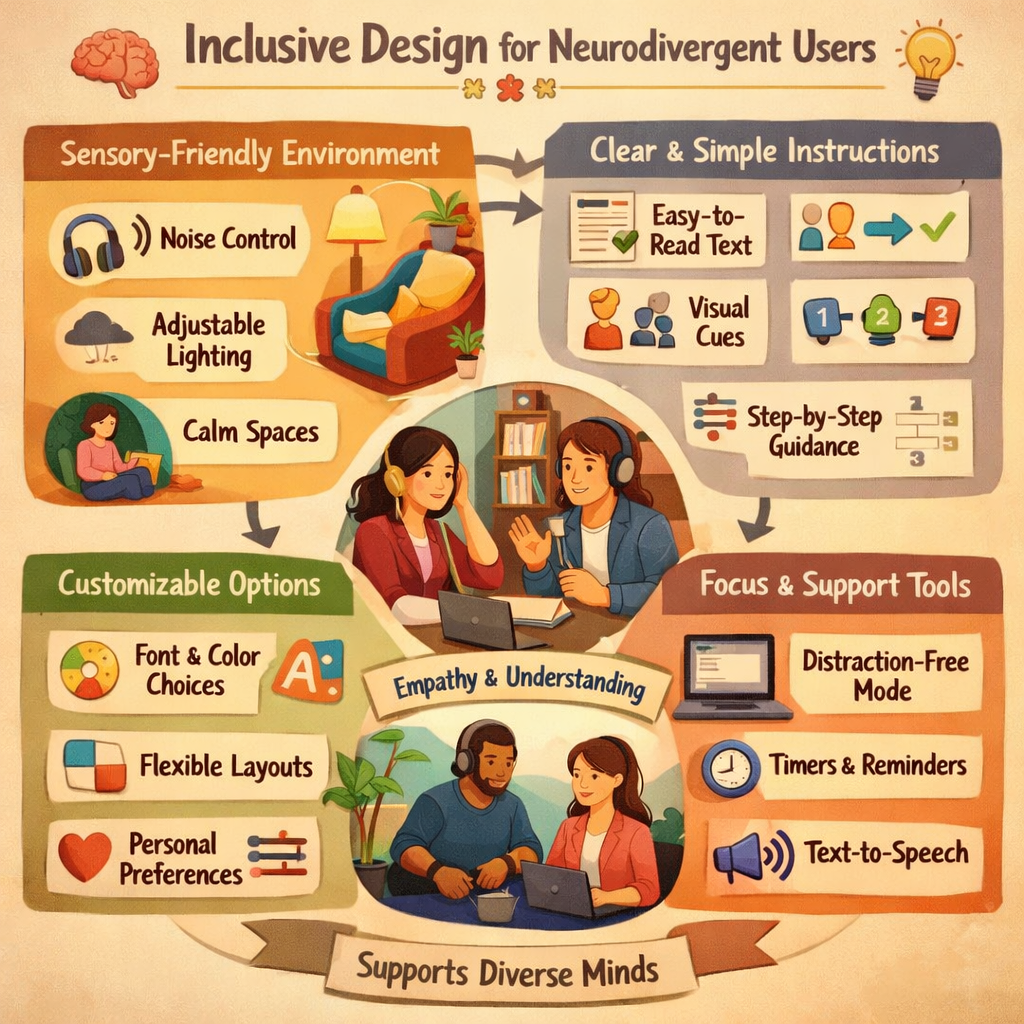
Designing for neurodivergent users doesn’t mean creating separate experiences. It means building flexible, low‑friction systems that benefit everyone.
Cognitive accessibility research consistently points to several principles that translate directly to omnichannel strategy:
1. Consistency Is Cognitive Safety
Keeping navigation, language, and interaction patterns consistent across channels reduces cognitive effort and builds trust. Users shouldn’t have to decode a new system every time they switch from email to web to mobile.
2. Clarity Beats Cleverness
Plain language, explicit labels, and predictable flows outperform creative ambiguity. Clear instructions reduce anxiety and support task completion for users who process information literally or sequentially. [xcgtech.com]
3. Control Reduces Overload
Autoplay, infinite scroll, and forced animations remove user agency. Giving users control over motion, sound, and pacing is a cornerstone of cognitive accessibility. [xcgtech.com]
4. Chunking Lowers Cognitive Load
Breaking information and processes into smaller, clearly labeled steps helps users with executive‑function challenges stay oriented and engaged. This approach consistently improves completion rates for all users. [rootcode.io]
Why Acceptance Shows Up in the Metrics
Designing for neurodivergence isn’t just inclusive—it’s measurable.
Organizations that improve cognitive accessibility often see:
- fewer abandoned forms
- fewer support escalations
- higher task‑completion rates
- stronger customer trust
When users spend less energy figuring out how to use a system, they can focus on why they’re there. That’s the foundation of effective omnichannel engagement. [216digital.com]
From Awareness to Acceptance
Autism Acceptance Month emphasizes a critical shift:
acceptance is not symbolic—it’s operational.
It shows up in how systems are designed, how choices are presented, and how predictable experiences feel across channels. Accessibility isn’t a layer added at the end; it’s infrastructure built into the journey from the start. [autismsociety.org]
For omnichannel teams, the message is clear:
If your experience only works for one way of thinking, it doesn’t truly work.
Omnichannel Takeaway
Neurodivergent users are not outliers. They are customers, employees, patients, and partners navigating increasingly complex digital ecosystems.
Autism Acceptance Month is a reminder that great omnichannel design is calm and consistent by default.
When we design for neurodivergent minds, we don’t narrow our audience.
We expand it.
