From my point of view, most organizations strive to be omnichannel.
They talk about omnichannel. They plan for omnichannel. They invest in tools and platforms with omnichannel in mind. But in reality, very few organizations are truly operating in an omnichannel state.
Most are organized or digitized at best—and that’s not a failure. It’s simply the truth of where transformation actually begins.
Omnichannel excellence doesn’t happen overnight, and it doesn’t happen because one team or one leader declares it so. Omnichannel is a North Star—a shared direction that requires alignment, persistence, and a team committed to learning together over time.

Omnichannel Is a North Star, Not a Switch
One of the biggest misconceptions I see is the belief that omnichannel is something you “turn on.”
In reality, omnichannel is not a single initiative, platform, or campaign model. It’s a way of operating—one that evolves as an organization matures. The goal isn’t to reach some mythical end state, but to continuously move closer to delivering connected, relevant, and intentional experiences.
There is no right or wrong way to get there. What matters is having a clear North Star and a team empowered to guide the organization toward it.
The Reality: Aspiration vs. Maturity

Most organizations want to be intelligent and fully connected. Very few start there.
What I see far more often is this:
- Teams believe they are omnichannel because they use multiple channels
- Execution is still siloed by function or platform
- Data exists, but isn’t consistently connected or actionable
- Decisions are driven more by habit than insight
This is why it’s so important to be honest about maturity. You can’t transform what you won’t acknowledge.
The Five Stages of Omnichannel Maturity
Organizations typically move through five stages on the journey from aspiration to intelligence. These stages are not linear checkboxes, and many organizations operate in multiple stages at once.
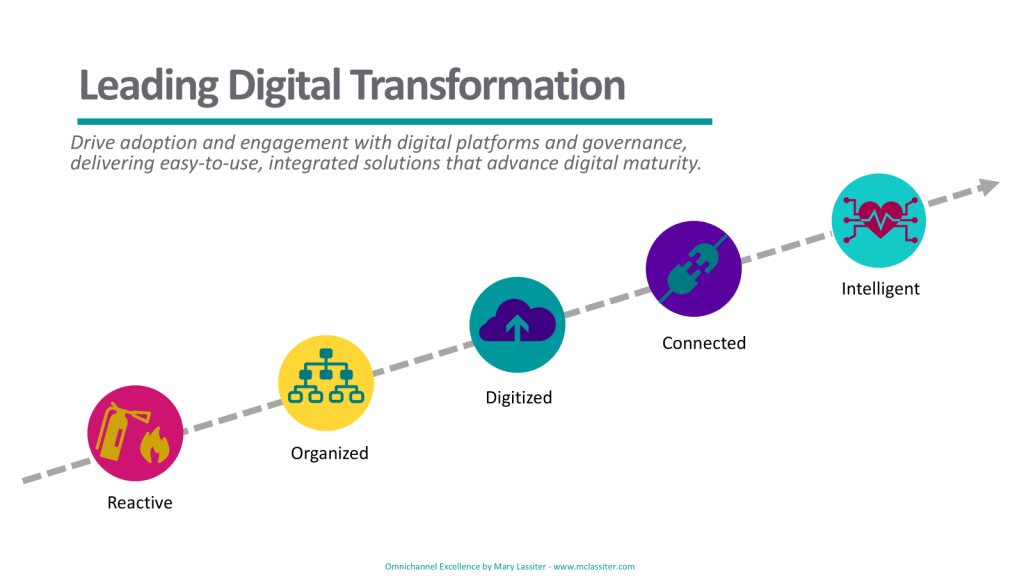
1. Reactive
This is where many journeys begin.
- Channels operate independently
- Work is driven by urgent needs and short timelines
- Success is measured by activity and output
- Data is fragmented or underused
Reactive doesn’t mean incapable—it means the organization is moving fast, often without shared structure or alignment.
2. Organized
Structure starts to take hold.
- Clear ownership across channels
- Defined processes and prioritization
- More predictable execution
- Early cross‑functional coordination
This is where many organizations begin to feel more in control—but orchestration is still limited.
3. Digitized
Enablement accelerates.
- Core workflows and content are digitized
- Platforms and tools support scale
- Data capture improves
- Teams begin using insights to inform decisions
This is often where organizations believe they are “omnichannel.” In reality, they are enabled, not yet connected.
4. Connected
True omnichannel capability begins here.
- Channels are orchestrated around journeys
- Data flows across systems and teams
- Experiences feel consistent and intentional
- Collaboration replaces handoffs
Connection requires coordination—and coordination requires a team aligned to the same North Star.
5. Intelligent
Relevance becomes the focus.
- Insights guide engagement
- Experiences adapt based on behavior and context
- Teams focus on next‑best actions and outcomes
- Learning is continuous and embedded
Intelligence isn’t about perfection or automation for its own sake. It’s about making better decisions, faster, together.
Transformation Takes a Team

Omnichannel transformation is not owned by a single function.
It takes:
- Leadership aligned around a shared vision
- Cross‑functional teams willing to break silos
- Clear governance balanced with flexibility
- A culture that values learning over certainty
The organizations that succeed are the ones that stop chasing maturity labels and start investing in capability, collaboration, and continuous improvement.
A Sample Omnichannel Roadmap: What’s Possible

This roadmap isn’t a prescription—it’s a reflection of what I’ve seen work in the real world.
Phase 1: Align on the North Star
- Define what omnichannel means for your organization
- Align leaders and teams around shared principles
- Clarify ownership and decision‑making
Outcome: Direction and alignment
Phase 2: Strengthen the Foundation
- Organize processes and ways of working
- Digitize critical workflows and content
- Improve data quality and accessibility
Outcome: Stability and speed
Phase 3: Connect Experiences
- Orchestrate channels around customer journeys
- Integrate data across systems
- Coordinate field, digital, and non‑personal efforts
Outcome: Consistency and cohesion
Phase 4: Learn and Optimize
- Test, learn, and refine engagement strategies
- Use insights to guide planning
- Shift from campaigns to experiences
Outcome: Smarter execution
Phase 5: Scale Intelligence
- Apply predictive insights and next‑best actions
- Personalize responsibly and transparently
- Embed omnichannel thinking into culture
Outcome: Sustainable omnichannel excellence
The Real Measure of Success
Omnichannel excellence isn’t about claiming an intelligent state.
It’s about progress over time, guided by a clear North Star and powered by teams willing to learn together.
Most organizations won’t start omnichannel.
Many will operate organized or digitized for longer than they expect.
And that’s exactly how transformation is supposed to work.
Omnichannel doesn’t just happen.
It’s built—intentionally, collaboratively, and one step at a time.

Let’s Discuss Your Omnichannel Journey
Every omnichannel journey is different.
Set up a meeting today and let’s have a candid conversation about where you are today, where you want to go, and how to guide your organization there—together.
